In this article
Why Most Ads Fail — And It's Not What You Think
Most advertisers approach their ads by asking: "What problem does my product solve?" They craft copy around the problem, list the features, and explain the benefits. Logical. Thorough. And almost always wrong.
The problem with problem-focused advertising is that it assumes customers are in a constant state of active search — that they wake up every morning acutely aware of their pain and ready to buy. They're not. People live with their problems indefinitely. Acne for years. Bad sleep for months. A mediocre Google Ads account for two years and counting. The problem alone doesn't make them buy. Something else does.
Before even thinking about pictures, videos, and carousels, you need to frame not just the problem you're solving — but the moment that made solving it urgent. That moment is the trigger.
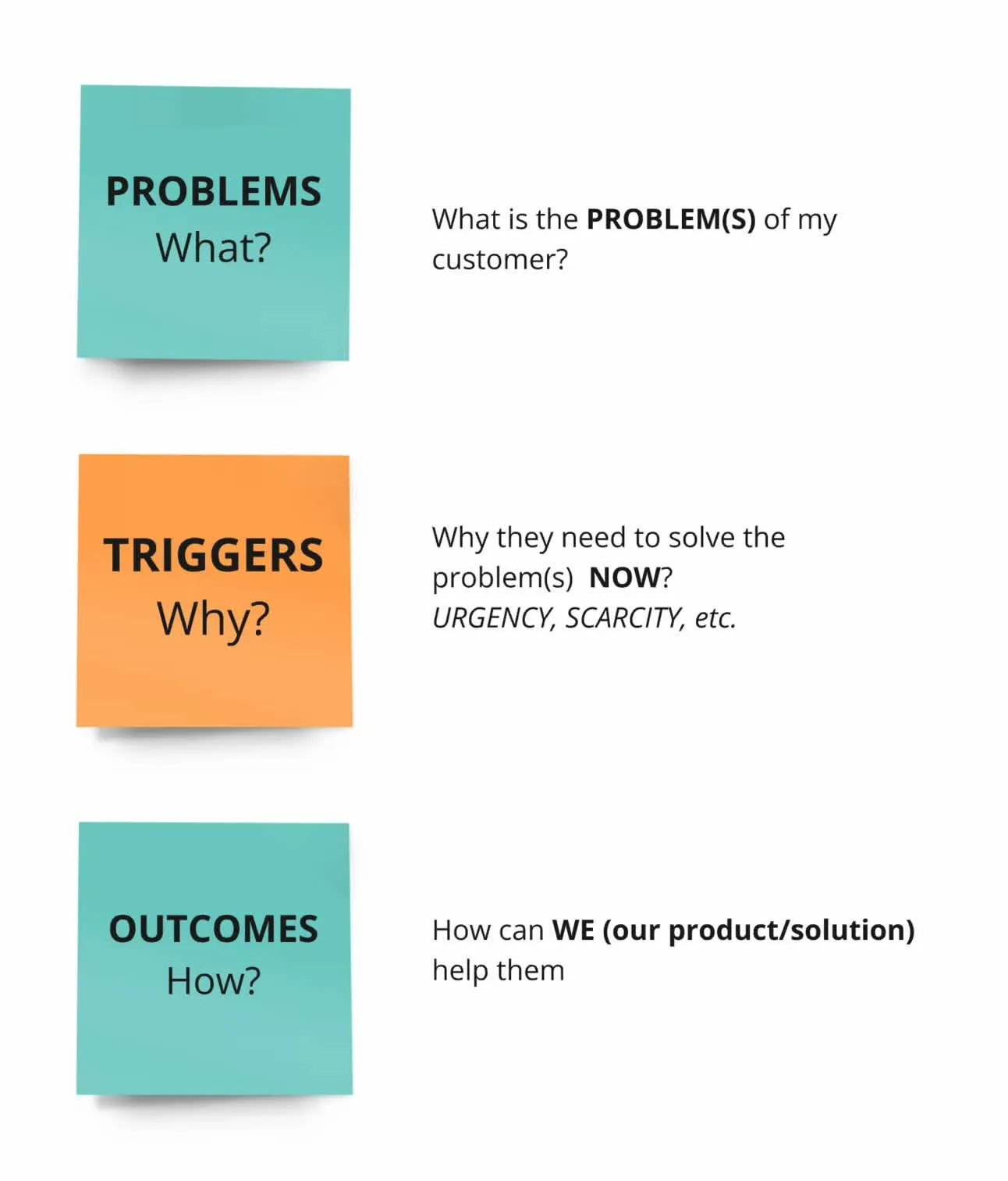
The Framework: Problem → Initial Status → Trigger → Solution → Benefit Status
Every purchase is a story with five chapters. Most advertisers only write chapter one. Here's the full arc:
| Stage | What it means | Example (acne product) |
|---|---|---|
| Problem | The chronic pain the customer has been living with | Has acne — has had it for two years |
| Initial Status | The emotional state the problem creates | Embarrassed, avoids photos, feels insecure in social situations |
| Trigger | The specific event that makes action feel urgent NOW | Has a first date in 10 days and wants to feel confident |
| Solution | Your product or service | Fast-acting acne treatment with visible results in 7 days |
| Benefit Status | The new emotional state after using the solution | Clear skin, walks into the date with confidence, no anxiety about photos |
Customers are willing to solve a problem because the solution unlocks a new status for them. Understanding the initial status and the benefit status is how you write ads that feel human rather than mechanical.
What Is a Trigger?
A trigger is the event — often recent, often external — that transforms a passive problem into an urgent need. It's the difference between "I should do something about this" and "I need to fix this right now."
Triggers have a few defining characteristics:
- They are time-bound. A trigger creates a deadline. The date is in 10 days. The wedding is in three months. The new job starts Monday. Time pressure converts intent into action.
- They are emotionally charged. Triggers are linked to feelings — fear of embarrassment, excitement about an opportunity, shame after a comparison, hope sparked by seeing someone else's result.
- They are often invisible to the advertiser. The customer rarely announces their trigger. They just start searching with more urgency. That's why you have to go looking for it.
- They are not the problem. This is the critical distinction. Acne is the problem. The date is the trigger. Your ad that says "got acne?" speaks to the problem. Your ad that says "want to feel confident in your skin by the weekend?" speaks to the trigger. One is generic; one feels personal.
Examples Across Different Product Types
| Product | Problem | Initial Status | Trigger | Benefit Status |
|---|---|---|---|---|
| Acne treatment | Persistent acne | Embarrassed, avoids mirrors and social photos | First date booked for next weekend | Clear skin, confident, present in the moment |
| Google Ads coaching | Wasting ad budget, low ROAS | Frustrated, feels like ads are a money pit | Just burned through €2,000 with zero sales in a week | Profitable campaigns, understands what's happening, in control |
| Online fitness course | Overweight, low energy | Avoids beach trips, self-conscious | Friend posted a transformation photo; wedding is in 4 months | Visible results, energy is back, proud of how they look |
| Local restaurant | Bored of cooking at home every night | Tired, uninspired, food feels like a chore | Partner's birthday is this Saturday | Memorable evening, partner impressed, feels like a good partner |
| SaaS productivity tool | Team missing deadlines, communication chaos | Stressed, manager is losing trust in the team | Missed a critical client deadline last week | Projects on track, team looks professional, manager satisfied |
Notice how the trigger column is always specific, always recent, and always emotionally loaded. It's the event that tips the scales. Without the trigger, the problem is just background noise. With it, your product becomes the answer to an urgent question.
How to Find Your Customer's Trigger
You won't find triggers by guessing. You find them by listening — in the right places.
1. Amazon and App Store Reviews
Go to competitors' products. Filter by 4 and 5-star reviews and read the ones that explain why the person bought, not just what they thought of the product. Look for phrases like "after X happened, I finally..." or "I needed this for..." These are trigger confessions in plain language.
2. Reddit and Online Communities
Subreddits dedicated to your product category are trigger goldmines. People post when their problem hits a peak — "I'm going on vacation in two weeks and my skin is a disaster, what do I do?" That's a trigger in real time. Read these threads, screenshot the language, use it verbatim in your copy.
3. Google Search Terms Report
If you're running Google Ads, your Search Terms report tells you what people typed just before clicking. Urgency words — "fast," "quick," "this week," "before," "tonight" — signal that a trigger is active. Seasonal clusters tell you which life events are driving demand. This is the most underused data source in performance marketing.
4. Customer Calls and Sales Conversations
Ask every new customer: "What made you decide to get this now, as opposed to six months ago?" The answer is almost always a trigger. Record these calls. The patterns will show you your best ad angles within weeks.
5. Your Own Reviews and Testimonials
Read your existing reviews with fresh eyes, looking specifically for the before-state. "I was struggling with X when Y happened" — that's the trigger. The best testimonial copy often contains the best ad copy, hiding in plain sight.
The Difference Between Solving a Problem and Hitting a Trigger
Here's where most advertisers get confused. They think being trigger-aware means adding more urgency words to their problem-focused copy. "Fix your acne — fast!" is still problem-focused. It's just louder.
Hitting a trigger means reframing the entire angle of the ad around the event, not the problem. The problem becomes implied context. The trigger becomes the opening hook. The benefit status becomes the promise.
When you solve a problem in your ad, you attract people who are mildly aware of their issue. When you hit a trigger, you attract people who are right at the moment of decision — the ones most likely to convert today, at full price, with no discount required.
How Triggers Change Your Ad Copy
| Generic Ad | Trigger-Based Ad | Why It Works |
|---|---|---|
| "Struggling with acne? Try our dermatologist-recommended treatment." | "Want to feel confident in your skin before the weekend? Our serum works in 7 days — or your money back." | Creates a time frame (weekend), speaks to the emotional outcome (confidence), removes risk (guarantee) |
| "Wasting money on Google Ads? Learn how to fix it." | "Still bleeding ad budget with nothing to show for it? Book a session and let's fix your account this week." | Acknowledges the frustration, implies it can be fixed quickly, makes the next step concrete |
| "Get fit with our online training program." | "Saw a friend's transformation and felt something shift? Here's how to start getting your body back — in 30 minutes a day." | Names the specific trigger (comparison moment), answers the unspoken objection (lack of time) |
| "Manage your team more effectively with our project tool." | "Missed a deadline that mattered? Stop it from happening again — your team can be fully aligned by Monday." | Triggers shame (missed deadline), creates urgency (by Monday), frames the product as a fast fix |
Timing Matters: Seasonal and Life-Event Triggers
Some triggers are personal and unpredictable — the date, the accident, the email that made everything feel urgent. But many triggers follow patterns you can plan for.
Seasonal triggers are tied to the calendar. New Year brings resolution energy (fitness, finance, habits). Valentine's Day triggers relationship-linked purchases. Summer brings body-confidence triggers. Back-to-school triggers productivity and organization purchases. The Q4 holiday season compresses huge amounts of gift-motivated buying into a short window.
Life-event triggers are tied to transitions: getting a new job, having a baby, moving to a new city, starting a business, going through a divorce, turning 40. These are often the most powerful triggers because they create identity-level urgency — the person is actively redefining who they are, and your product can be part of that new identity.
If your product has natural seasonal or life-event triggers, build campaign calendars around them. Don't just increase budget in Q4 — change your ad copy to reflect the specific trigger that's active in that moment. A fitness app ad in January should look radically different from the same ad in August.
Your ads are speaking to the problem. They should be speaking to the trigger.
In a single coaching session, we'll identify your customer's real triggers and rebuild your ad copy around them.
Frequently Asked Questions
What is a trigger in advertising?
A trigger is the specific event or moment that makes a person's existing problem feel urgent and unbearable right now. It's not the problem itself — it's what happened recently that made them finally search for a solution. Ads that speak to the trigger feel personal and timely; ads that only speak to the problem feel generic.
How is a trigger different from a pain point?
A pain point is the chronic problem a customer lives with. A trigger is the acute event that makes them act. Someone might have had acne for two years (pain point), but the trigger is the dinner date they booked for next weekend. The pain point explains why they want a solution; the trigger explains why they want it NOW.
How do I find my customer's trigger?
Start with Amazon and app store reviews — look for phrases like 'I finally decided to...' or 'After X happened, I needed...' Reddit threads in relevant subreddits are goldmines. Your own customer calls and sales conversations are the best source. Also look at Google Search terms — people searching at 11pm with very specific language are often mid-trigger.
Should I mention the trigger directly in my ad?
Yes, but indirectly. You don't say 'are you going on a date next week?' — that's creepy. You say 'want to feel confident in your skin by the weekend?' The trigger frames the timing and emotional context without being invasive. The goal is for the reader to think 'this ad is talking to me right now.'
Can one product have multiple triggers?
Absolutely. One of the biggest mistakes in advertising is trying to write one ad that speaks to everyone. A fitness app might have triggers like: starting a new job, a wedding coming up, a breakup, a doctor's warning, or a friend's visible transformation. Each trigger deserves its own ad with its own copy and creative. Segment your triggers, then segment your ads.
Continue Learning
This framework is just the beginning. In Part 2 of the Triggers series, we look at how to translate triggers into visceral, reaction-based ads — why primal beats intellectual every time. And if you want to see where triggers fit into the full page structure, read the landing page structure guide.
- Facebook Ads Coaching — apply trigger-based frameworks to your Meta ad creative with expert guidance
- Google Ads Coaching — use trigger psychology to write Google Ads copy that generates clicks and conversions
- Facebook Ads for Authors — trigger-based ad strategy for books and creative work