In this article
Quick Recap of Part 1
In Part 1 of this series, we established the core framework: customers don't buy because they have a problem. They buy because a specific event — a trigger — made their problem feel urgent and unbearable right now. The five-stage arc is: Problem → Initial Status → Trigger → Solution → Benefit Status. Ads that speak to the trigger convert at a fundamentally higher rate than ads that speak to the problem alone.
This article is about what happens next — how you actually translate that trigger insight into ads that provoke a reaction rather than just register as a message.
The Problem with "Clever" Advertising
There are two modes an ad can operate in. The intellectual mode: the viewer reads the ad, processes it, evaluates it, forms an opinion, decides whether it's relevant. The primal mode: the viewer sees the ad and something in them moves before they've consciously parsed a single word.
Most advertising today operates in intellectual mode. Not because advertisers are bad at their jobs — but because intellectual advertising feels safer. It's defensible in a creative review. It explains the product clearly. It hits the brief. It checks all the boxes.
It just doesn't work very well.
The moment you require your audience to think, you've given them the opportunity to decide it's not relevant to them. You've introduced friction. And friction, in advertising, is fatal. People don't slow down to carefully evaluate your Facebook ad while they're scrolling through their feed at 11pm. They make a split-second judgment about whether something matters to them and then they move on.
The job of the ad is not to inform. It's to stop the scroll — and then to feel so personally relevant that not clicking would feel like leaving something on the table.
Audience Size and Trigger Framing
When creating a campaign — or more broadly, a marketing strategy — we need to be aware of the problem we are solving. A narrow audience is not inherently a bad thing. In fact, it can be advantageous because it allows us to identify potential customers more easily and create a highly precise value proposition.
However, if we frame a problem that is too small, we won't have enough critical mass to test our assumptions effectively. To address this, it's often beneficial to take the problem a couple of levels higher. Unless the product has an extremely specific use case, aim to target a broader problem or a cluster of related problems first.
Here's the tension: trigger-based copy is specific, but the audience it needs to reach may be broad. The solution is to frame the trigger at the right level of abstraction. "Going on a date next week" is too narrow as a trigger — most people seeing your acne ad won't be going on a date next week specifically. But "want to feel confident in your skin before something important?" is specific enough to create recognition while broad enough to catch the wedding, the job interview, the reunion, and the date.
You're not broadening the trigger into a generic statement. You're lifting it one level higher so it captures the emotional category, not just the specific event.
What Makes a Trigger Visual? The Rolls-Royce Example

TRIGGERS are the why behind someone's desire to solve a problem. I don't just want to get rid of acne — I want to look better so I can confidently ask someone out. That's my trigger. If you build your ad solely around problem-solving, you might struggle to hit your customers' "bullseye." But if you place a TRIGGER at the core of your campaign, you're more likely to evoke a strong emotional response.
Consider this, probably the most famous ad created by David Ogilvy:
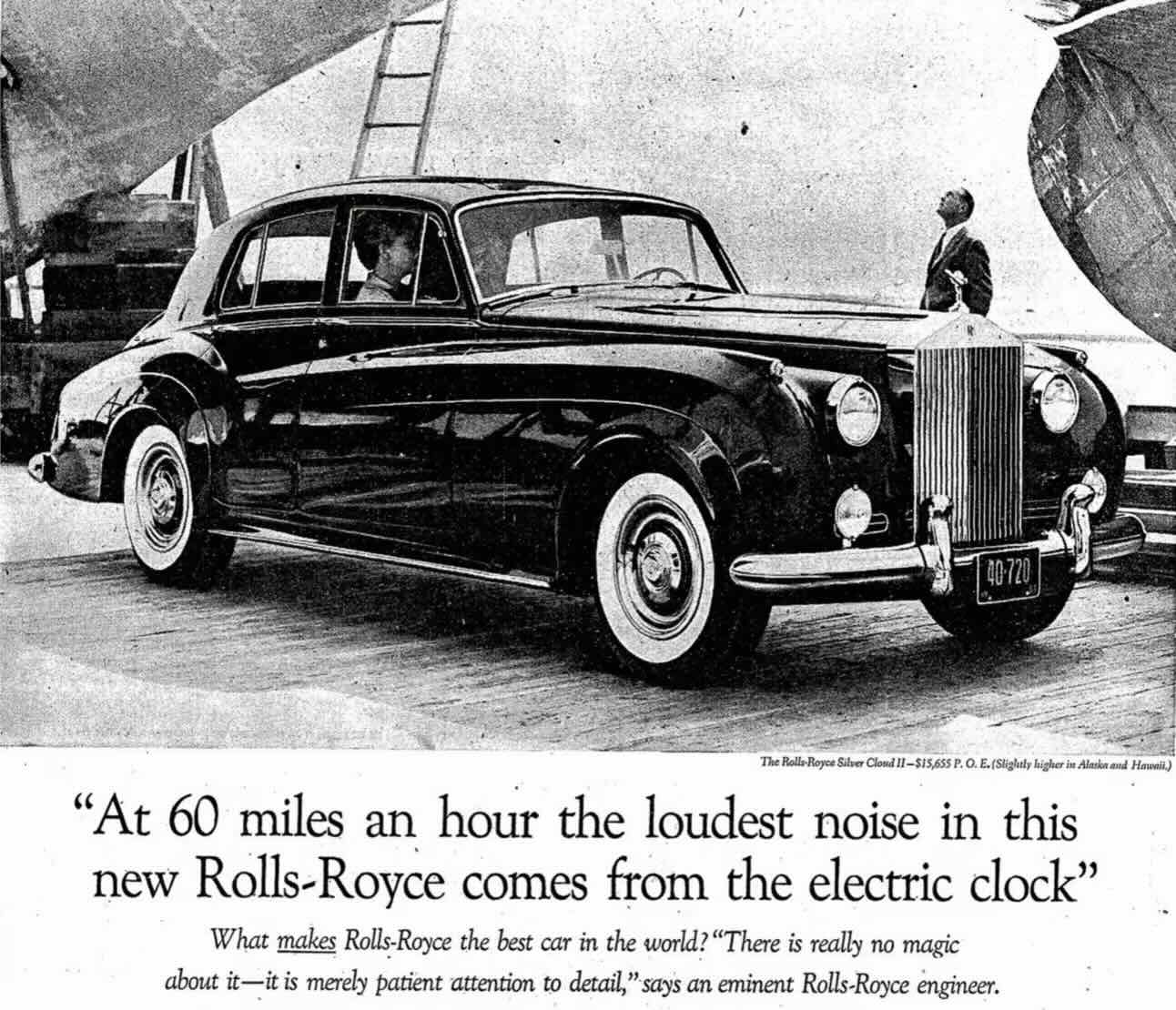
It's old stuff, I know, but this is all you need to know.
The visual is immediately arresting: a successful man in a position of confident composure, the car as environment rather than object. The headline — "At 60 miles an hour the loudest noise in this new Rolls-Royce comes from the electric clock" — doesn't explain the car. It puts you inside it. You feel the silence. You feel the quality that surrounds you. The headline is a sensory experience delivered in one sentence.
What is the trigger here? It's not "I need reliable transportation." It's not even "I want a nice car." The trigger Ogilvy is activating is something like: "I want to feel like the kind of person who has earned this level of quiet, this level of quality, this degree of success that manifests itself in the details." The Rolls-Royce ad works because it doesn't sell the car. It sells the feeling of being the person who owns one.
The product is the portal. The trigger is the desire to step through it.
That principle transfers completely to a Facebook video ad in 2026. The product is still the portal. The trigger is still the desire for a new status, a new feeling, a new identity. Your creative just has two seconds to open that portal instead of two minutes of leisurely readership.
Analyzing Real Ads: Can You Spot the Trigger?
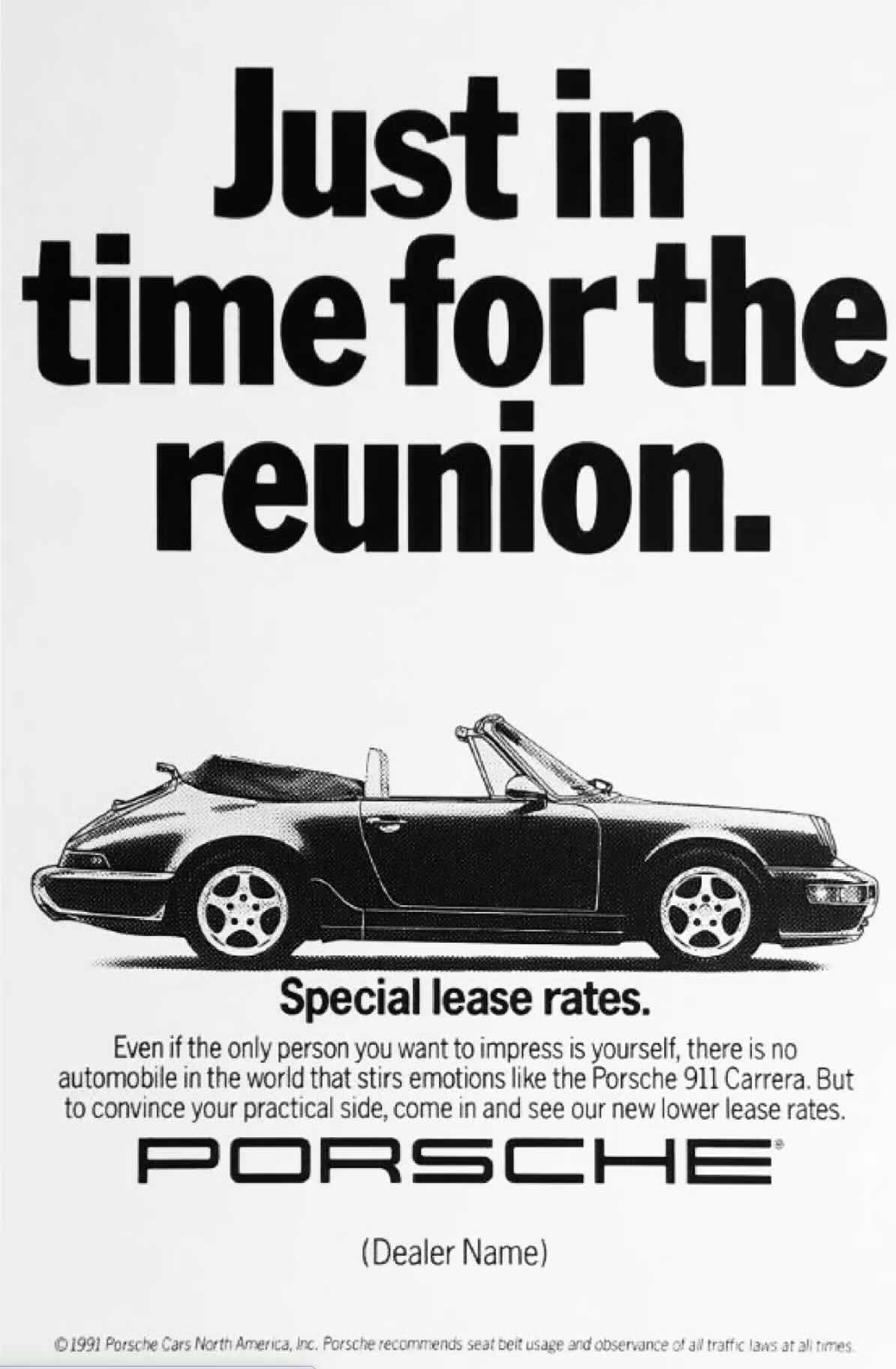
Take a look at this ad. The trigger here is not "I need a fast car." That's a feature, not a feeling. The trigger being activated is closer to: "I've worked hard. I've earned things. I want to feel the physical sensation of that — to sit inside something that responds to me, that performs when I ask it to, that confirms I am the kind of person I have worked to become."
It's an identity trigger. It's a reward trigger. It connects to something deep — the desire for the body to feel what the mind has already decided. And the ad communicates all of this without saying any of it directly. That's the craft. The trigger is felt, not stated.
Aim for Reaction, Not Perception
Here is the single most important instruction for building high-performing ads: design for reaction, not perception.
Perception is when someone sees your ad and thinks: "Oh, that's an interesting product. I can see how that would help someone. I might look into that." Perception leads to brand awareness. It leads to vague recall. It does not reliably lead to clicking, buying, or remembering you when the trigger activates.
Reaction is when someone sees your ad and something shifts in them before they've fully processed what they're looking at. Their thumb slows. Their chest tightens. They feel something — recognition, longing, anxiety, hope — and they click because not clicking would mean leaving that feeling unresolved.
The gap between perception and reaction is enormous. And the gap between "we got a reaction" and "we got a click, and then a purchase" is what separates good advertising from great advertising.
To engineer a reaction, you need to understand exactly what emotional state your trigger creates — and then amplify that state in your creative, not explain it. Don't describe anxiety to someone who is anxious. Show them their anxiety reflected back with surgical precision. They'll click because they've never felt so seen.
Don't be intellectual. Be primal. With your visual and with your text.
Applying This to Digital Ads in 2026
The principles Ogilvy operated on haven't changed. The medium has changed dramatically. Here's how the classic principles translate:
| Traditional Advertising Principle | How It Applies to Facebook/Instagram/Google Ads in 2026 |
|---|---|
| The headline is 80% of the ad | The first frame of your video or the first line of your primary text is 80% of your ad. If it doesn't stop the scroll, nothing else gets read. |
| Sell the experience, not the product | Show the benefit status — the feeling of already having solved the problem — not the product itself. UGC that opens with someone mid-transformation outperforms product demos every time. |
| Know exactly who you're talking to | On Meta, the algorithm handles targeting — but only if your creative is specific enough to select itself. An ad that speaks to one trigger, one status, one specific person will find that person. A broad ad finds no one. |
| Specificity creates credibility | Specific numbers, specific timeframes, specific results — "I went from $0 to $18,000/month in 90 days" — outperform vague promises in every category. Specificity signals honesty, and honesty converts. |
| Make one argument well | Ads that try to communicate three benefits get zero reactions. Pick one trigger. Make one argument. Create one feeling. Then test a different angle with a different creative. |
| Social proof is more powerful than claims | A customer speaking to their trigger ("After my third failed launch I finally tried this and...") is infinitely more powerful than any brand claim. Collect these testimonials and run them as ads. |
Writing Copy That Creates Reactions
The fastest way to improve your copy is to look at what you have and ask: does this describe the product, or does this describe the feeling? Then move everything toward the feeling.
| Perception Copy | Reaction Copy | What Trigger It Fires |
|---|---|---|
| "Our skincare line uses advanced formulations to reduce acne." | "You've tried everything. This is what actually works — and it works in 7 days." | Frustration fatigue + urgency + proof of speed |
| "Learn Google Ads from an expert with 10 years experience." | "Stop watching your ad budget disappear. One session and you'll know exactly what's broken — and how to fix it." | Financial anxiety + desire for control + concrete next step |
| "Our fitness program combines cardio and strength training for full body results." | "She asked me what I'd been doing differently. I'd been doing this for 8 weeks." | Social comparison trigger + aspiration + achievability |
| "Streamline your project management with our intuitive platform." | "Your team won't miss another deadline. This week, you'll actually leave on time." | Professional embarrassment + desire for normalcy + time-bound promise |
| "Get 30% off our bestselling supplement bundle this month." | "My energy was gone by 2pm every day. Then I fixed what I was missing." | Identification (2pm energy crash is universal) + curiosity + hope |
The Role of Specificity
There's a counter-intuitive truth about advertising specificity: the more specific your copy is, the more people it resonates with. Not fewer people — more.
This seems backwards. Surely "lose weight fast" speaks to more people than "lost 23 lbs in 11 weeks without giving up pasta." The first is universal; the second is one person's story.
But here's what happens psychologically. When someone reads "lose weight fast," their brain categorizes it as advertising — generic, unprovable, forgettable. When they read "23 lbs in 11 weeks," something different happens. Their brain processes it as information, because it's specific enough to be true or false. Specificity signals credibility. And credibility creates trust. And trust creates clicks.
More than that: the right specific detail will find the right specific person. The person who reads "23 lbs in 11 weeks without giving up pasta" and has been dreading giving up pasta will feel this is written for them. That feeling of personal relevance is worth more than any targeting optimization you'll ever run.
Specificity is also how you communicate the trigger without stating it directly. "Before my company's all-hands, I was a wreck about how I looked on camera" is specific enough that anyone who's felt that way will lean in — even if their specific event was different.
Your ads are too clever. Let's make them primal.
One session to audit your creative, identify what trigger you should be hitting, and rewrite your copy from the ground up.
Frequently Asked Questions
What does 'make me click' mean in advertising?
It means designing ads that provoke an instinctive, almost involuntary response — not ads that require the viewer to think, evaluate, and decide. When an ad 'makes you click,' you don't consciously weigh the pros and cons. You react. That reaction is what you're aiming for. Cognitive friction kills conversions; emotional resonance creates them.
How do I write ad copy that gets an emotional reaction?
Start with the trigger (the event that makes the problem urgent), then speak to the feeling it creates — not the problem in the abstract. Use specific, sensory language: not 'improve your finances' but 'stop checking your bank balance and feeling sick.' Use the exact words your customers use in reviews and conversations. Specificity triggers recognition; recognition triggers emotion.
What is the difference between features and triggers in ad copy?
Features describe what your product does. Triggers describe what made someone need it. 'Our course has 12 modules and lifetime access' is a feature. 'Finally get your Google Ads account profitable — before you burn through another month of budget' is a trigger. Features answer the question 'what is it?' Triggers answer the question 'why do I need this right now?'
How specific should my ad copy be?
Much more specific than you think. The instinct is to keep copy broad to appeal to more people. But specificity creates recognition — when someone reads copy that describes their exact situation, they feel seen, and that feeling converts. 'Lost 23 lbs' outperforms 'lost significant weight' every time. The right specific detail will resonate strongly with your best customers and be irrelevant to people who aren't a fit — which is fine.
What is the Ogilvy approach to advertising?
David Ogilvy believed that the most powerful ads make the reader feel something before they think anything. His Rolls-Royce ad ('At 60 miles an hour the loudest noise in this new Rolls-Royce comes from the electric clock') doesn't explain what a Rolls-Royce is or list its features. It puts you inside the car. You experience the silence. You feel the status. The product becomes the portal to an emotional experience — and that experience is what you're really selling.
Continue Learning
If you haven't read Part 1 of the Triggers series, start there — it covers the Problem → Trigger → Solution framework that underpins everything in this article. Then read the landing page structure guide to see how trigger-based ad copy flows into a landing page that converts.
- Facebook Ads Coaching — translate primal trigger frameworks into high-performing Meta campaigns
- Google Ads Coaching — build trigger-driven ad copy for search intent
- Facebook Ads for Life Coaches — trigger-based advertising for coaches whose product is transformation